


Kitchen countertop burn marks, deep scratches, and embedded stains that no cleaning product touches are not a cleaning problem. They are structural surface damage that cleaning cannot address. Tub Coaters provides professional kitchen countertop refinishing throughout Baltimore, Nottingham, MD, and Washington, DC, restoring laminate, cultured marble, tile, and solid surface countertops with MHIC license #97786, full general liability insurance, and workers compensation coverage. With 26+ years of experience and 130,000+ completed projects, our licensed technicians fix what cleaning cannot. Read verified results on the Better Business Bureau, Yelp, Angi, and Houzz. Available 24/7 throughout Baltimore and Washington, DC. Call (410) 324-6057 for your complimentary countertop assessment.
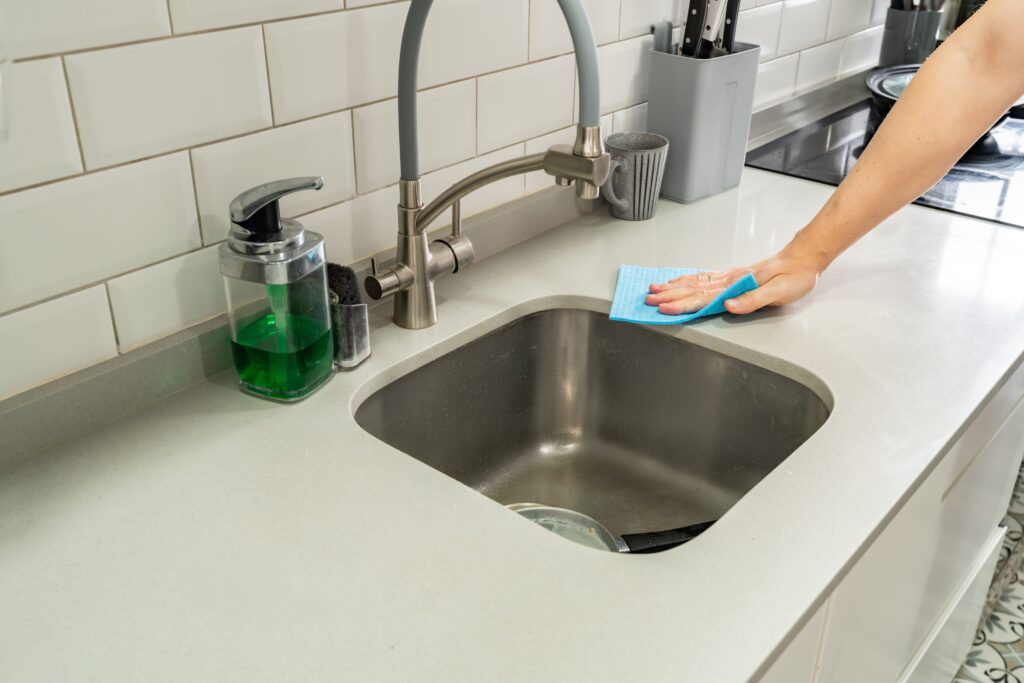
Why Cleaning Does Not Work on These Kitchen Countertop Problems
Cleaning products work by dissolving, lifting, or chemically breaking down contaminants that sit on a surface. Burn marks, deep scratches, and certain types of staining are not contaminants sitting on the surface. There are changes to the surface material itself. No cleaning product can reverse material destruction.
Baltimore and DC homeowners who have spent significant effort trying different cleaning products, scrubbing agents, degreasers, and commercial surface cleaners on burn marks and deep scratches report the same result: temporary improvement in appearance from removing debris, followed by the same visible damage remaining unchanged. This is exactly the expected result when cleaning methods are applied to structural material damage. The diagnosis is not the wrong cleaning product. The diagnosis is the wrong type of intervention.
Why Kitchen Countertop Burn Marks Won’t Come Off
What Heat Does to Laminate Countertops
Laminate countertops consist of a decorative surface layer bonded to a particleboard or MDF core. The decorative layer is a thermoplastic material that responds to heat by softening, melting, and eventually charring. When a hot pan, hot baking sheet, or hot small appliance contacts laminate without a trivet or protective pad, the heat transfer is immediate and destructive.
The thermoplastic decorative layer melts at the contact point. The melted material may stick to the hot object and pull away from the countertop surface, or it may char in place while the heat continues to penetrate. The result is a discolored, depressed, or raised area of damaged material that no cleaning agent can reverse because the material itself has been chemically and physically altered by heat. Cleaning removes soot and debris but cannot restore melted thermoplastic to its original state.
What Heat Does to Cultured Marble and Solid Surface
Cultured marble and solid surface countertops contain polyester or acrylic resin binders that respond to heat by softening, yellowing, and, in extreme cases, blistering. Direct heat contact causes resin breakdown that changes the material’s appearance and surface texture permanently at the contact point. The discolored or blistered area represents altered resin chemistry that no cleaning product addresses. In milder heat exposures, cultured marble shows a localized yellowing or white patch at the heat contact point from resin oxidation.
Why Some Stains Also Resist Cleaning
Certain kitchen staining types also resist all cleaning attempts for reasons related to chemistry rather than material destruction. Wine tannins, fruit pigments, turmeric, and berry compounds bond chemically to laminate and cultured marble surfaces with extended contact time. The chemical bond between these pigments and the surface material cannot be broken by cleaning products that dissolve or lift surface contaminants. Additionally, micro-porosity in aging countertop surfaces allows these staining compounds to penetrate below the cleaning-accessible surface layer, where cleaning agents cannot reach them.
Why Deep Scratches on Kitchen Countertops Also Won’t Buff Out
How Scratches Form on Laminate
Deep scratches on laminate countertops penetrate through the decorative surface layer into the backing material beneath. The scratch represents physically displaced or removed material. No cleaning or polishing process can restore missing material to a scratch channel. Consumer scratch repair products for laminate fill scratches temporarily with wax or filler compounds that wear away with use. They do not bond permanently to the laminate substrate or match the surface texture and color with the precision that professional repair achieves.
How Scratches Form on Solid Surface and Cultured Marble
Solid surface countertops including Corian and similar materials, are theoretically renewable through sanding because the decorative material extends through the full thickness of the counter. However, consumer sanding attempts on these materials create inconsistent surface texture and require professional-level finishing to restore a uniform appearance. Cultured marble with deep scratches has penetrated the gel coat surface into the composite material beneath, creating a visible texture and color change that amateur sanding and polishing attempts rarely fully address.
The Damage Types That Tell You Refinishing Is the Right Solution
These conditions indicate the countertop surface has sustained damage beyond what cleaning or consumer repair can address:
- Burn marks showing discolored, melted, or depressed laminate surface at heat contact points from pots, pans, or small appliances
- White or yellowed patches on cultured marble at heat contact locations, where resin oxidation has occurred
- Deep scratches that catch a fingernail when run across the surface, indicating penetration below the decorative layer
- Staining from wine, berries, turmeric, fruit juice, or other pigment-rich foods that cleaning has reduced but not eliminated after multiple attempts
- Edge delamination or lifting, where the laminate decorative layer has separated from the particleboard core
- Chips or missing sections of the laminate decorative layer reveal the darker backing material beneath
- Overall surface dullness on cultured marble that polishing attempts have not restored
For kitchen tile countertops showing grout staining and tile discoloration, our companion guide on why old tile kitchen countertops look dirty even after cleaning explains that specific issue in detail.
What Professional Kitchen Countertop Refinishing Actually Does
Professional kitchen countertop refinishing addresses burn marks, deep scratches, and embedded staining through a systematic process that repairs structural surface damage before applying a fresh, unified surface coating.
Damage Repair First
Before any refinishing coating is applied, all damage receives professional repair using commercial-grade fillers appropriate for the specific countertop material. Burn mark depressions fill to the surface level. Deep scratch channels fill and level with the surrounding material. Chipped edge sections are rebuilt to their original profile. These repairs address the structural surface irregularities that make damaged areas visible.
Surface Preparation
Complete surface preparation removes all contamination including embedded staining, mineral deposits from water contact, and any residue from previous cleaning or repair attempts. Industrial-strength cleaning agents not available in retail channels address chemically bonded staining. Surface etching creates the adhesion profile that bonding primer requires for lasting performance.
Coating Application
Bonding primer applies in multiple thin coats before multiple topcoat layers via professional HVLP spray equipment. Kitchen countertop topcoat systems use heat-resistant and stain-resistant formulations appropriate for kitchen use demands. The completed surface is uniform, smooth, and free of any evidence of the original burn marks, scratches, or staining.
Color and Finish Options
Refinishing is not just restoration. It is also an opportunity to update kitchen aesthetics. Contemporary white and gray options replace outdated almond, beige, or other discontinued colors. Faux granite, quartz, and marble finishes create a premium stone countertop appearance at a fraction of the stone replacement cost. Custom colors coordinate with updated cabinet paint, hardware, and kitchen design elements.
Why Refinishing Beats Countertop Replacement in Baltimore and DC
Full countertop replacement in Baltimore and DC kitchens involves professional measurement, fabrication lead times for custom-sized countertops, demolition of existing surfaces, plumbing disconnection at the kitchen sink, installation, and reconnection spanning multiple days. Non-standard kitchen configurations common in older Baltimore properties may require custom fabrication that extends timelines and increases costs further.
Professional refinishing completes in three to five hours in a single visit, requires no plumbing disconnection for countertop-only projects, delivers results in 24 to 48 hours, and addresses the actual damage conditions that replacement would also eliminate. For structurally sound countertops with cosmetic surface damage, refinishing consistently delivers better total value than replacement.
Kitchen Countertop Damage and Baltimore and DC Home Sales
Kitchen and bathroom presentation significantly influence buyer decisions in Baltimore and DC real estate markets. Burn marks and deep scratches on kitchen countertops create immediate negative impressions that reduce buyer confidence in the property’s overall maintenance. These visible damage conditions provide buyers with negotiation leverage for repair credits that often exceed the cost of professional refinishing. Baltimore and DC homeowners preparing to list their properties benefit from professional countertop refinishing that eliminates these buyer-visible conditions within the rapid timeline pre-listing preparation requires.
Coordinate kitchen countertop refinishing with bath vanity top refinishing and complete bathtub refinishing and reglazing for a comprehensive pre-listing surface restoration program covering both kitchen and bathroom surfaces in a coordinated project sequence that creates consistent, updated presentation throughout the property.
Our Kitchen Countertop Refinishing Process
- Assessment: Countertop material identification, damage evaluation (burn marks, scratches, staining, edge condition), and color or finish preference discussion.
- Surface cleaning: Industrial-grade removal of all contamination including chemically bonded staining that conventional cleaners cannot address.
- Damage repair: Commercial-grade filler repairs burn mark depressions, deep scratches, chips, and edge delamination to create a smooth, level surface.
- Surface preparation: Complete etching creates the adhesion profile bonding primer requires for lasting performance.
- Masking: Complete protection of cabinets, backsplash, appliances, and all adjacent kitchen surfaces.
- Primer and topcoat application: Heat-resistant and stain-resistant countertop primer and topcoat in multiple thin coats via professional HVLP spray equipment.
- Fresh caulking at all countertop seams. Kitchen available for light use in 24 hours and full cooking use in 48 hours.
For kitchens where the sink also shows staining or damage, countertop and sink refinishing addresses both surfaces in a single coordinated project visit. For comprehensive kitchen and bathroom property updates, Tub Coaters also coordinates tub surround and tile reglazing and bathroom ceramic floor tile refinishing to prepare complete property surfaces for listing.
Local Context: Kitchen Countertop Conditions in Baltimore and DC Homes
Baltimore and Washington, DC residential properties across construction eras present specific countertop damage patterns. Baltimore County and Prince George’s County homes built from the 1970s through the 1990s commonly feature original laminate countertops now 30 to 50 years old, showing accumulated burn marks, deep scratches, and staining from decades of kitchen use. These countertops remain structurally sound with particleboard cores in acceptable condition, making refinishing the appropriate and economical intervention.
DC rowhouses and Baltimore City properties updated during the 1980s and 1990s often contain cultured marble countertops showing heat discoloration, mineral staining, and surface crazing appropriate to their age. These materials respond well to professional refinishing that addresses all accumulated surface conditions and restores the original bright, smooth appearance.
Tub Coaters serves Baltimore, Nottingham, Washington, DC, and all surrounding Maryland and Northern Virginia communities with professional kitchen countertop refinishing. Our work carries MHIC license #97786, verifiable through the Maryland Home Improvement Commission licensing database.
When to Call Tub Coaters About Your Kitchen Countertop
Call as soon as you recognize that cleaning has failed to address visible burn marks, scratches, or staining. The longer these conditions remain unaddressed, the more the surrounding area accumulates secondary damage from altered cleaning habits, improper repair attempts, and ongoing kitchen use on a compromised surface. Professional refinishing is most straightforward when countertop damage is cosmetic without extensive particleboard water damage or structural compromise.
Why Baltimore, Nottingham, and DC Homeowners Choose Tub Coaters for Kitchen Countertop Refinishing
| What We Offer | What It Means for You |
| Licensed MHIC#97786 by the Maryland Home Improvement Commission | Your project is covered by verified, state-certified expertise |
| Fully Insured (General Liability + Workers Compensation) | Zero liability for you if anything goes wrong on site |
| BBB Accredited Business | Third-party verified track record of customer satisfaction |
| 26+ Years Serving Baltimore, Nottingham, MD, and Washington, DC | Deep regional knowledge and a proven local reputation |
| 130,000+ Completed Projects | Experience across every countertop material, damage type, and condition |
| Same-Day Completion on Most Projects | Your kitchen is back in use within 24 to 48 hours |
| Faux Stone and Custom Color Options Available | A fresh aesthetic update alongside structural surface repair |
| Available 24/7 for Assessments and Urgent Pre-Sale Timelines | We respond when your timeline demands it, at any time of day |
Frequently Asked Questions: Kitchen Countertop Burn Marks and Scratches
Why won’t kitchen countertop burn marks clean off?
Burn marks on kitchen countertops do not clean off because the damage is not surface contamination, it is physical destruction of the countertop material. On laminate countertops, direct heat contact from hot cookware melts the thermoplastic laminate layer and chars the backing material below it. The damage is structural: the laminate layer has been thermally destroyed at that point and no cleaning product can reverse molecular-level heat damage to a synthetic material. On cultured marble, heat damage causes similar material breakdown in the composite resin structure. Cleaning removes soot and surface debris but leaves the underlying material damage unchanged.
Why do deep scratches on kitchen countertops stay visible after cleaning?
Deep scratches on kitchen countertops remain visible after cleaning because they are physical surface deformation, not contamination. On laminate countertops, deep scratches penetrate through the decorative top layer into the backing material, creating a groove that cleaning products flow over without restoring the material that was displaced or damaged. On solid surface countertops, deep scratches expose interior material that differs visually from the intact surface. Cleaning removes debris from within scratches but cannot replace the material that is missing or the surface continuity that the scratch destroyed.
Can professional refinishing remove kitchen countertop burn marks?
Yes. Professional kitchen countertop refinishing addresses burn marks through a systematic process that repairs the damaged area using appropriate commercial-grade filler materials, prepares the entire surface to uniform condition, and applies industrial-grade topcoat that creates a fresh, uniform surface across the complete countertop. The repair process addresses the structural damage that burn marks represent by filling and leveling the affected area before topcoat application. The result is a countertop surface that shows no evidence of the original burn damage.
What types of kitchen countertops can Tub Coaters refinish?
Tub Coaters refinishes laminate countertops in all brands and patterns, ceramic and porcelain tile countertops with grout, cultured marble countertops, solid surface countertops, and acrylic countertops in kitchen applications. Laminate countertop refinishing is particularly valuable for addressing burn marks and deep scratches because laminate is the most common material for these damage types and the most economical countertop material where replacement cost relative to refinishing cost makes the greatest practical difference.
Is kitchen countertop refinishing safe for food preparation surfaces?
Yes. Tub Coaters uses EPA-compliant coating materials that cure to inert, food-contact-safe surfaces in kitchen applications. Full cure develops over seven days after application, during which the coating achieves maximum hardness and chemical stability. After complete curing, all refinished kitchen countertops are safe for regular food preparation activities. Our technician confirms the specific curing timeline for your project’s coating system during project completion.
How long does kitchen countertop refinishing take?
Most kitchen countertop refinishing projects in Baltimore and DC complete in three to five hours from technician arrival to project completion, depending on countertop size and surface condition. Kitchen access returns within 24 hours for light tasks and within 48 hours for regular food preparation. The brief access restriction compares favorably to the multi-day timeline of countertop replacement, which requires measurement, fabrication lead time, demolition, installation, and plumbing reconnection.
Can refinishing fix a kitchen countertop edge that has peeled or lifted?
Yes. Laminate countertop edge peeling and lifting represents one of the most common repair scenarios in Baltimore and DC kitchen countertop refinishing projects. Edge damage on laminate occurs when moisture penetrates the laminate-to-particleboard bond at edge joints, causing delamination. Professional repair re-adheres lifted sections, seals edge joints against future moisture infiltration, and refinishes the complete surface to create a uniform appearance. Extensive edge delamination with significant particleboard water damage may require assessment of whether particleboard replacement is needed before surface refinishing.
Why do kitchen countertop stains resist all cleaning products?
Kitchen countertop stains that resist all cleaning products have penetrated the micro-porosity of an aging countertop surface or bonded chemically to the surface material rather than sitting on it. On laminate, certain food dyes, wine tannins, turmeric, and berry pigments bond chemically to the laminate surface with prolonged contact, creating stains that cleaning agents cannot break. On cultured marble, porous surface micro-structure from aging allows these same compounds to penetrate below the cleaning-accessible surface layer. Professional surface preparation during refinishing uses industrial-strength products not available in retail channels that address these chemically bonded stains.
Can kitchen countertop refinishing include a color change?
Yes. Kitchen countertop color-change refinishing is one of the most popular applications of this service for Baltimore and DC homeowners. Contemporary white, gray, and beige options update outdated kitchen color schemes. Faux granite, quartz, and marble finish options create the appearance of premium stone countertops at a fraction of stone replacement cost. Custom colors coordinate refinished countertops with updated cabinet paint, hardware, and kitchen design elements without requiring full countertop replacement.
Is kitchen countertop refinishing a good investment before selling a Baltimore or DC home?
Yes. Kitchen presentation significantly influences buyer decisions and offer amounts in Baltimore and DC real estate markets. Buyers evaluate countertop condition as an indicator of overall kitchen maintenance and property care. Burn marks, deep scratches, and staining on kitchen countertops create negative buyer perceptions that reduce offer amounts and provide negotiation leverage for repair credits. Professional refinishing delivers the visual improvement buyers respond to within the rapid pre-listing timeline that sellers need. See our guide on how surface restoration helps home sellers for additional context on this common scenario.
Can refinishing be done on kitchen countertops around a sink?
Yes. Kitchen countertop refinishing addresses all countertop surfaces including areas adjacent to and around kitchen sinks. The sink basin receives masking and protection during countertop refinishing. Fresh silicone caulking at all countertop-to-sink seams completes the project and creates a clean, updated seal between these surfaces. For sinks showing their own staining or surface damage, standalone countertop and sink refinishing combines both surfaces in a single project visit.
How long do refinished kitchen countertops last?
Professionally refinished kitchen countertops last 10 to 15 years with proper care and maintenance. The kitchen environment imposes more demanding conditions on refinished surfaces than bathroom applications, making maintenance practices particularly important. Using cutting boards for all food preparation, placing trivets under hot cookware, wiping spills immediately, and using mild non-abrasive cleaners all contribute to maximizing refinishing longevity within the 10-to-15-year range.
Can professional refinishing fix a kitchen countertop that someone tried to repair with a DIY kit?
Yes, with appropriate assessment of the DIY repair’s condition. Well-adhered previous DIY repair can serve as a base for professional refinishing with appropriate surface preparation. Failing, peeling, or poorly adhered DIY repair requires complete removal before professional refinishing proceeds. Our technician evaluates the condition of any previous repair attempts during the initial assessment and provides specific preparation recommendations. Previous DIY repair attempts are a common scenario that our technicians handle regularly throughout the Baltimore and DC service area.
What is the difference between kitchen countertop refinishing and resurfacing?
Kitchen countertop refinishing and resurfacing describe the same professional surface restoration process using different terminology. Both terms refer to the systematic cleaning, preparation, repair, priming, and topcoat application that restores countertop surfaces to factory quality. Reglazing and recoating are also common synonyms for the same service. The quality of results depends entirely on preparation depth, coating material performance, and application technique, not on which terminology a contractor uses.
How do I schedule kitchen countertop refinishing in Baltimore, Nottingham, or Washington, DC?
Call (410) 324-6057 to schedule a complimentary on-site assessment for your kitchen countertop. Our technician evaluates the countertop material, damage extent, color options, and finish preferences, then provides a detailed project scope and timeline. Most kitchen countertop refinishing projects schedule within one to two weeks of the initial assessment. Pre-listing and urgent timeline requests receive priority scheduling. Tub Coaters serves Baltimore, Nottingham, Washington, DC, and all surrounding Maryland communities.
Get Kitchen Countertop Damage Fixed, Not Just Cleaned
Your kitchen countertop burn marks and deep scratches have a permanent fix that cleaning never delivers. Tub Coaters provides professional kitchen countertop refinishing throughout Baltimore, Nottingham, and Washington, DC, backed by MHIC license #97786, full general liability insurance, workers compensation coverage, 26+ years of experience, and 130,000+ completed projects. Our process repairs structural damage, eliminates embedded staining, and delivers heat-resistant and stain-resistant coating systems that last 10 to 15 years. Read customer results on Yelp, Trustpilot, and Wheree. Call (410) 324-6057 today for your complimentary kitchen countertop assessment and get a surface that is actually fixed, not temporarily improved.